 The
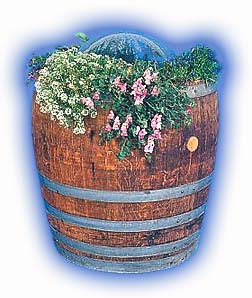
Sun Frost Scrap Eater - A Stylish, High-Tech Composter
Creating mineral-rich soil from your table scraps is finally
convenient, clean and easy with the Sun Frost Scrap Eater - a state of
the art "living machine." This composter is a highly functional piece
of appropriate technology that is also stylish and fun to use.
Plants growing in the soil on the
perimeter of the Scrap Eater feed directly off nutrients that you
create in the composting section. This miniature ecosystem composts
food scraps in a sealed compartment so you can display the Scrap Eater
on a deck, porch or even an apartment patio without concern about
odors, insects or animals.
“My
Sun Frost Scrap Eater is a bottomless pit. I’ve had it almost three
years and it’s still only two-thirds full. My roommate’s and my diets
are mostly vegetarian, so there are plenty of scraps being tossed in
every day. The cork screw stirrer makes mixing easy. And I like the
design—it’s a nice addition to my patio with sapphire blue lobelia
draped against the natural wood wine barrel. The worms love it too.”
-
Margaret Emerson, Sunny Brae, California
Engineered to be the Best
You will enjoy this beautiful addition to your home for many years. The
Scrap Eater is an attractive garden planter, as well as an efficient
composter. Sun Frost has applied its experience in industrial design
and solar technology to create the most effective, sturdy and compact
composter on the market. Measuring about three feet high and two feet
in diameter, this composter is constructed of 3/4 of a solid oak
Bordeaux wine barrel. The clear dome is made of acrylic plastic, a
material that resists solar degradation.
Why Compost?
Composting is an environmentally friendly way
to get rid of your kitchen and garden scraps. Microorganisms in the
compost cleanly and conveniently convert plant scraps into humus, the
same natural fertilizer that develops on the forest floor and nourishes
the world's trees. The Scrap Eater helps keep your garbage can clean
and odor-free by accepting foods that would otherwise rot and produce
odors, while saving you money on trash pickups and extending the life
of landfills.
|
A Living Machine
The Scrap Eater is the only truly solar-powered composter. A warm
environment accelerates the composting process. Using conventional
techniques a compost pile at least 3 ft. across is needed to obtain the
necessary elevated temperatures. To compensate, the Sun Frost Scrap
Eater uses solar architectural techniques, glazing and insulation to
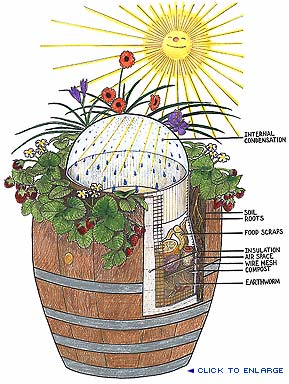
attain elevated temperatures. The insulated walls of the composting
chamber trap solar heat collected through the dome, along with heat
generated internally by respiration of composting microbes. A unique
feature of this insulation is its ability to keep the heat in, while it
allows oxygen to freely flow to the composting microbes.
 The unique shape of the acrylic bubble not only
collects solar energy, but channels water to where it is needed most.
Water that condenses on the inside of the dome runs down to the plants
on the perimeter of the barrel. This process has a dual purpose. First,
it reduces the need to water the plants because they are receiving
water from the condensation under the dome. Second, the water is
flowing to the outer perimeter rather than dripping into the composting
chamber, which reduces the moisture level of the compost and the amount
of dry material that must be added to the compost. The unique shape of the acrylic bubble not only
collects solar energy, but channels water to where it is needed most.
Water that condenses on the inside of the dome runs down to the plants
on the perimeter of the barrel. This process has a dual purpose. First,
it reduces the need to water the plants because they are receiving
water from the condensation under the dome. Second, the water is
flowing to the outer perimeter rather than dripping into the composting
chamber, which reduces the moisture level of the compost and the amount
of dry material that must be added to the compost.
When the plants growing on the
perimeter of the composter mature they will extend their roots to the
bottom of the compost chamber and directly extract nutrients and
moisture from the composted food scraps. This process continues the
natural cycle much like it occurs in the wider biosphere.
 Using
the Composter Using
the Composter
The Scrap Eater is easy to use: just add your kitchen scraps, then
periodically mix the pile with the supplied stirrer and add some dry
material to the mix - some dry grass, dry leaves, or a little sawdust.
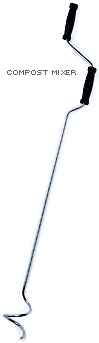
The crank-style stirrer is made of solid stainless steel. It is
extremely easy to use and does an excellent job of keeping the compost
aerated. When the Scrap Eater fills up - in about six months for a
family of four, and two years or more for a single-person household -
you can remove the compost for use. The compost is a perfect plant
fertilizer that can be used anywhere in your garden, including the
growing area on the perimeter of your Scrap Eater.
How it Works
The Scrap Eater can be used to rapidly compost large batches of food
scraps at one time, but is typically used by adding small amounts of
scraps every few days. The ability of the composter to rapidly
decompose food scraps decreases the rate at which the chamber fills up.
As food scraps decompose they will decrease in volume by 20 times or
more. Where does the food go? Part of the material is lost through
evaporation, but most of the scraps are consumed by the hungry microbes
in the composter and exhausted as carbon dioxide and water vapor.
If large quantities of food are
added at one time, higher composting temperatures may be attained.
Temperatures as high as 150°F may be generated with the addition of at
least 1 cubic foot of the right combination of food and dry material.
Conventional composters require 30 times the material to reach these
high temperatures.
Vermiculture
Worms may also be added to the Scrap Eater to assist in the composting
process. They help to aerate the soil while  producing a very effective soil additive. The
compost chamber will typically be 30°F above the ambient temperature
and during the summer may be too hot for the worms. To avoid these warm
conditions the worms will migrate to the cooler perimeter where the
plants are growing. As they migrate, nutrients from the composting area
will be transported to the plants growing on the perimeter. producing a very effective soil additive. The
compost chamber will typically be 30°F above the ambient temperature
and during the summer may be too hot for the worms. To avoid these warm
conditions the worms will migrate to the cooler perimeter where the
plants are growing. As they migrate, nutrients from the composting area
will be transported to the plants growing on the perimeter. |